|
|
 Active Galactic Nuclei (AGN), and their distant luminous versions, the quasars, represent one of the major unsolved problem of astrophysics. AGN emit huge quantities of energy emerge from a very small space, with a spectral energy distribution unlike any other astronomical object, and have a habit of ejecting twin jets of material at relativistic velocities. There is a fairly strong presumption that the underlying process is accretion of matter onto a supermassive black hole, but progressing from there to a believable detailed theory has proved very difficult.
Unified Schemes.
One of the problems has been the complex and confusing phenomenology, and a bewildering variety of "types" of AGN. I have written a number of papers working towards a unified scheme for AGN (see for example my review papers in 1987 and 1999.)
A popular idea is that narrow-line AGN are the same as quasars but hidden by an obscuring "torus" of dust, and that in fact most quasars are obscured, and are seen as luminous IR galaxies. I have simultaneously been part of developing this idea, and of criticising it. Example papers are from 1991, 1999, and a recent (2010) ApJ paper looking at the idea of obscuration by warped discs resulting from chaotic accretion. I am currently working on tests of the warped disc idea, especially with a combined WISE-UKIDSS-SDSS sample. My current PDRA Isaac Roseboom just led a paper deriving the distribution of covering factors for high luminosity quasars, showing pretty good agreement with the warped disc model.
AGN variability.
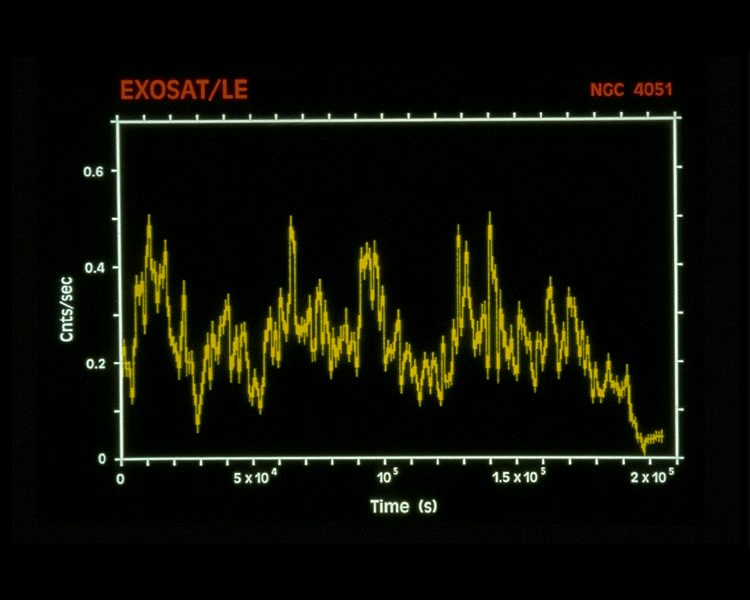 AGN vary rapidly, especially in X-rays. Potentially this holds clues to the Physics of AGN we can't get any other way. My 1987 Nature paper on NGC 4051 had the first light curve of high enough quality to take this seriously, but showed a featureless power law power spectrum. In a 1993 paper Iossif Papadakis and I showed that the amplitude of the power spectrum correlates with luminosity, probably due to an underlying correlation with black hole mass, a suspicion strengthened by finding unnusually fast variability in the least luminous known AGN, NGC4395. This was work led by Paulina Lira in 1999, Kazushi Iwasawa in 2000, and Jess Skelton in 2005. (I will soon be writing up other results from Jess' thesis, showing that the correlation really is with black hole mass.) With Omar Almaini and James Manners, we showed in a 2002 paper that this variability-luminosity relation changes at high redshift, probably because earlier than z=2, black holes were still growing, and typically accreting at higher rates. AGN vary rapidly, especially in X-rays. Potentially this holds clues to the Physics of AGN we can't get any other way. My 1987 Nature paper on NGC 4051 had the first light curve of high enough quality to take this seriously, but showed a featureless power law power spectrum. In a 1993 paper Iossif Papadakis and I showed that the amplitude of the power spectrum correlates with luminosity, probably due to an underlying correlation with black hole mass, a suspicion strengthened by finding unnusually fast variability in the least luminous known AGN, NGC4395. This was work led by Paulina Lira in 1999, Kazushi Iwasawa in 2000, and Jess Skelton in 2005. (I will soon be writing up other results from Jess' thesis, showing that the correlation really is with black hole mass.) With Omar Almaini and James Manners, we showed in a 2002 paper that this variability-luminosity relation changes at high redshift, probably because earlier than z=2, black holes were still growing, and typically accreting at higher rates.
An exciting new area is that of Tidal Disruption Events, where a star is ripped apart as it passes close to a quiescent black hole, leading to a months-long eruption of quasar-like activity. This idea has been talked about for years, with a handful of semi-convincing candidates from GALEX and SDSS-3. I am one of a team of people (led by Suvi Gezari) looking for these events in industrial quantities for the first time, using PanSTARRS-1. The most exciting initial result is in this Nature paper.
SEDs and accretion discs.
I have also worked on and off on the spectral energy distributions of AGN, and testing the hypothesis of accretion discs. Some tests look good. In a 2003 paper with Evlabia Rokaki, we showed that in AGN showing superluminal motions, where you can estimate the viewing angle, there are surface brightness and velocity effects with angle just as you would expect for a flat disc. In a 2005 paper I showed that the colour differences between objects of different luminosity show just the trend one expects for a thermal emitter. Then in this 2008 paper led by Makoto Kishimoto, we showed that after removing dust emission using cunning polarimetric techniques, the IR spectra of quasars show pretty much the long-predicted nu**1/3 shape.
However there are serious problems for accretion discs models in other places. Variability is simultaneous through the optical-UV, and colour changes with brightness much more steeply than it should. Quasar SEDS are too cool in the UV region, and have the wrong shape to explain the emission lines. All these things are a sign of the disc breaking down in the central regions. After some years of giving conference talks on this topic, I have finally written a substantial paper, in which I propose that the UV peak of the Big Blue Bump is actually a false peak caused by reflection from dense clouds surrounding the accretion disc, with the true peak being at 300 Angstroms.
High redshift quasars.
One of the goals of the UKIDSS survey has been to break past z=6.4, which has been the quasar redshift barrier for many years. In 2011. we did this in spectacular fashion, finding a quasar at z=7.085 (Mortlock et al 2011). I was only a minor player in that actual paper, but proud that UKIDSS has been meeting its goals ! To me the mots interestin g thing about that object is how you can make a billlion solar mass black hole only 770 million years after the Big Bang.
|