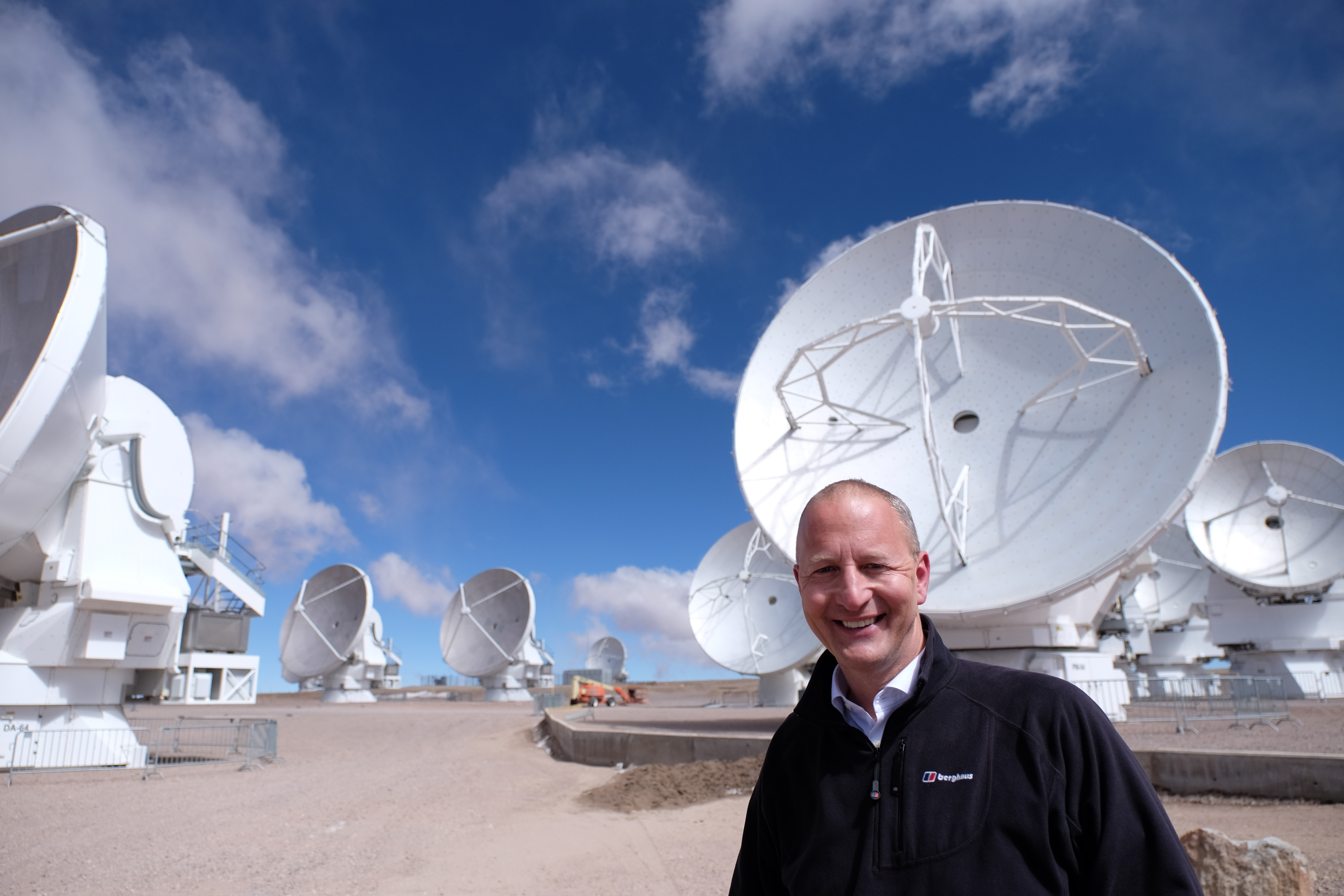
 I am an astronomer at the European Southern Observatory (ESO), and an emeritus/adjunct Professor at the University of Edinburgh, in Scotland, Macquarie University, in Sydney, and at the Dublin Institute for Advanced Studies, in Ireland. I was previously Director for Science at ESO (2014-23). I was previously Professor of Astrophysics at the Institute for Astronomy (IfA), which is part of the University of Edinburgh, an individual merit research scientist at the UK Astronomy Technology Centre, a PPARC Advanced Fellow (Ernest Rutherford Fellowships nowadays) at the IfA, and a lecturer at University College London.
 From 2013-18 I held an Advanced
Grant, COSMICISM
(related
publications; philosophical
aside), from the European
Research Council, which aimed to study the formation and evolution
of galaxies, mainly via observations at far-infrared, submillimetre
and radio wavelengths. I currently lead science projects with
the Atacama Large
Millimetre/Submillimetre Array (ALMA) in Chile and the National
Radio Astronomy Observatory's
Jansky Very Large Array
(JVLA) near Socorro in New Mexico.
My time is split between my duties at ESO, supervising PhD students, writing proposals to use or build telescopes, analysing data, and writing papers - 36 and 53 refereed papers as first and second author, respectively (all refereed, 1st author refereed; 2nd author refereed;
From 2013-18 I held an Advanced
Grant, COSMICISM
(related
publications; philosophical
aside), from the European
Research Council, which aimed to study the formation and evolution
of galaxies, mainly via observations at far-infrared, submillimetre
and radio wavelengths. I currently lead science projects with
the Atacama Large
Millimetre/Submillimetre Array (ALMA) in Chile and the National
Radio Astronomy Observatory's
Jansky Very Large Array
(JVLA) near Socorro in New Mexico.
My time is split between my duties at ESO, supervising PhD students, writing proposals to use or build telescopes, analysing data, and writing papers - 36 and 53 refereed papers as first and second author, respectively (all refereed, 1st author refereed; 2nd author refereed;  https://orcid.org/0000-0001-5118-1313) - working in a field I perceive to represent the divine intersection of science and art. What I do is esoteric by most standards, but normal in astrophysics. I meddle mainly with faint smudges in far-flung regions of the Universe. The golden rule seems to be that I get interested in things that are ridiculously difficult to study and explain.
THE DARK SIDE OF GALAXY FORMATION
 The submillimetre waveband gives access to redshifted far-infrared
emission from very dusty, active galaxies in the distant Universe - UV
photons from hot, young stars which have been absorbed by cool dust
particles and re-emitted at much longer wavelengths.
The submillimetre waveband gives access to redshifted far-infrared
emission from very dusty, active galaxies in the distant Universe - UV
photons from hot, young stars which have been absorbed by cool dust
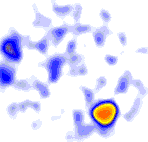
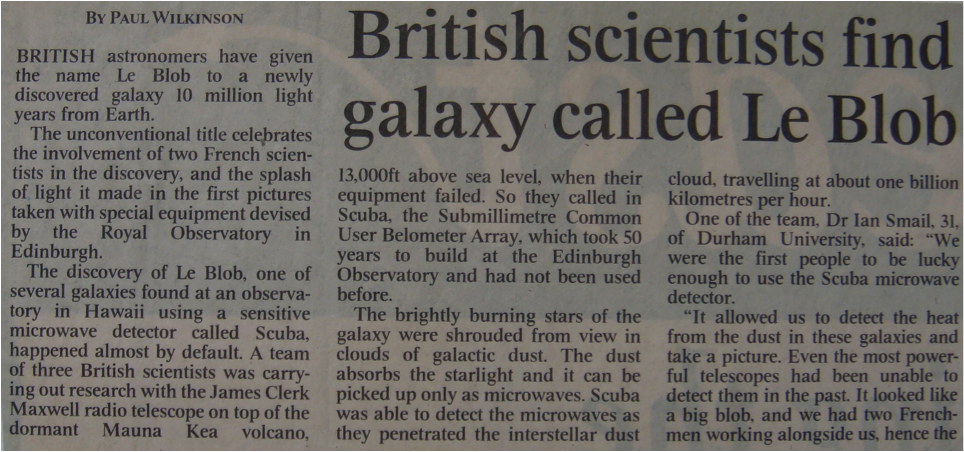
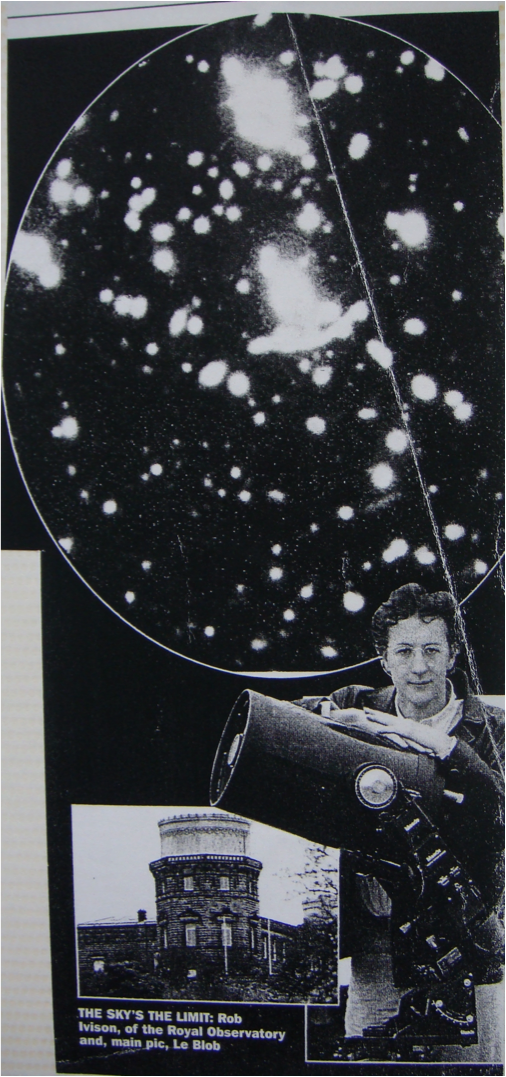
particles and re-emitted at much longer wavelengths.The first sensitive submillimetre surveys of the distant Universe were completed in 1997. The first map, taken through the massive lensing cluster, Abell 370, is shown to the left. The map was made with the SCUBA bolometer array on the 15-m JCMT, Hawaii. The bright source at the bottom of the image (`Le Blob' to its friends, or L1/L2) was the first `SCUBA galaxy' - SMM J02399-0136 at z = 2.8.
We know now that these objects can be extremely complex, comprising at
least three major components (L1, L1N, L2SW) in the case
of SMM
J02399-0136: 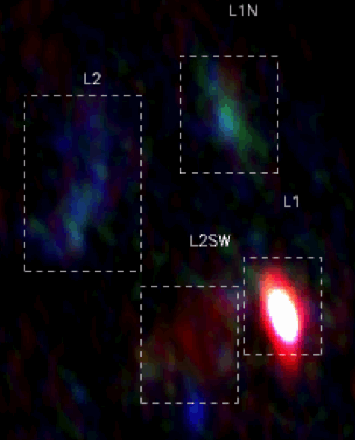 if we look in detail (see the Hubble Space
Telescope imaging on the right), we often find that the starburst
(L2SW in this case, identified via high-resolution radio imaging) is
faint (often invisible) in the UV/optical waveband, even in deep
post-SM4 HST imaging, with the optical light dominated by a BAL quasar
(labelled L1 here) which isn't responsible for much (if any) of the
submillimetre emission. Reddened or reflected starlight sometimes
leaks out on the periphery (L2 may be reflected light in this
particular case).
if we look in detail (see the Hubble Space
Telescope imaging on the right), we often find that the starburst
(L2SW in this case, identified via high-resolution radio imaging) is
faint (often invisible) in the UV/optical waveband, even in deep
post-SM4 HST imaging, with the optical light dominated by a BAL quasar
(labelled L1 here) which isn't responsible for much (if any) of the
submillimetre emission. Reddened or reflected starlight sometimes
leaks out on the periphery (L2 may be reflected light in this
particular case).
The far-infrared luminosity of a galaxy can be used to infer the rate at which it is forming stars (as most of the UV radiation comes from massive stars which don't live very long). The many 1000s of stars formed each year in most of these galaxies - together with the immense quantities of molecular gas that we infer via millimetric observations of carbon monoxide (CO) - indicate that we are probably seeing the formation of massive galaxies. Our surveys in this waveband have demonstrated that roughly half the star formation in the entire history of the Universe has occurred in highly obscured environments, invisible to surveys in the UV/optical. Investigating the detailed properties of this population is a very active field of study.
PERSONAL STUFF

I'm married to a divine Mackem lass, and we have two adorable/demonic children - one of each (ambiguity intended). I hail from Blackburn, Lancashire, which has a fine history of one-downsmanship (a concept lost on virtually all academics, and on folk of several particular nationalities). I'm a fan of Blackburn Rovers, for my sins, though I've made a largely successful effort to get `clean' of football. I attend manic, daily RPM/spinning classes in my local tennis centre, I run (slowly, painfully), play golf (astronomical handicap), potter in my garden and allotment, and spend 72/73rds of the year looking forward to Glastonbury. My Myers-Briggs personality type seems bang on the money, if you've been wtfing.
Last Modified: 14th November 2023.
Rob Ivison
ESO, Karl Schwarzschild Strasse 2, D-85748 Garching, Munich, Germany
Tel: +49-89-3200-6669 / Cell: +49-151-185-63-662 / email: rob.ivison [at] eso.org