
Episodic (variable) dust formation by WR stars
| WR140 Introduction |
| Colliding-wind binaries |
| WR140 orbital motion |
| WR48a - the system with the longest period |
| WR104 pinwheel |
| Massive Stars Web site |
| Galactic Wolf Rayet Catalogue |
WR 140, WR 137 and WR 19 are spectroscopic
binaries, HD 36402 appears to be a triple system comprising [16]
a WC4+O binary having a period near 3.03 days in a wider orbit with an O8I supergiant,
while WR 104 and WR 125 have spectroscopic companions suggesting binarity.
There are currently no RV orbits for the last two, but the WR 104 pinwheel
rotates on the sky with a period of 241.5 days
(Tuthill et al. 2008), indicating
dust formation by a binary observed at low inclination. The intensity of the
dust emission is constant, indicating formation of dust at a constant rate
exactly replenishing that flowing away from the system.
Another dust pinwheel is that formed by WR 98a,
whose infrared flux varies with the same period as its pinwheel
rotation, indicating periodic variation in the feeding of its dust cloud.
The variable WR dust makers are listed below.
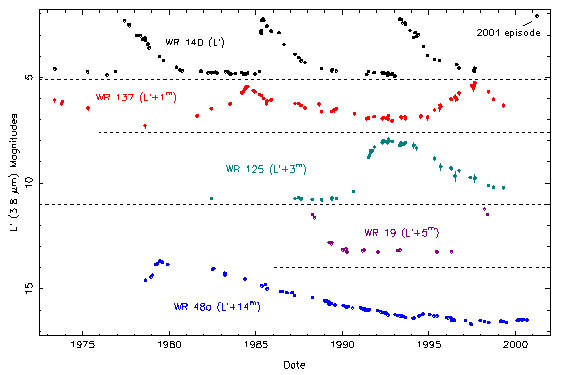
| star | spectrum | (inferred) observed infrared maxima | P(y) | refs | next max |
| WR 140 | WC7 + O5 | (1970), 1977, 1985, 1993, 2001, 2009, 2016 | 7.94 | [1], [2], [13] | 2024 |
| WR 137 | WC7 + O9 | (1971), 1984, 1997, (2010 caught by WISE) + mini episodes | 13.05 | [3], [4] | 2023 |
| WR 125 | WC7 + O9 | 1992.5, 2020 | ∼28 | [5], [11] | 2048 |
| WR 19 | WC5 + O9 | (1987), 1997-8, 2007, 2017 | 10.1 | [6], [12] | 2027 |
| WR 48a | WC8 + Oe | 1979, 2011 + mini episodes - variable dust formation | ~ 32.5 | [7], [9], [14] | 2044.2 |
| WR 98a | WC8-9 | 1991.1, 1992.7 ... 2000.4, periodic dust emission | 1.54 | [8], [9], [18] | 2017.4 |
| HD 36402 | WC4(+O) +O8I: | ~1996.9, 2011, 2016 | 5.1 | [15], [11] | 2021 |
| WR 46-7 | WC5-7 | 2004 ... 2010 ... 2015, 2016, 2019, | 1.49 | [11] | ~2021 |
| WR 65 | WC9 + OB | 1979-80 | ~ 4.8 | [17] | ~2017.8 |
| WR 47c | WC5 | 2004-10 broad maximum | >14 | [11] | ? |
| WR 91-1 | WC7 | 2014.2 | >14 | [11] | ? |
| HD 38030 | WC4 + OB | 2018 | >20 | [11] | ? |
| rev. 15 September 2020 Peredur Williams |
[1] Williams et al. MNRAS 243, 662, 1990
[2] Fahed et al. MNRAS 418, 2, 2011 (RV orbit: P = 2896.5 ± 0.7 d, e = 0.8962)
[3] Williams et al. MNRAS 324, 156, 2001
[4] Lefèvre et al. MNRAS 360, 141, 2005 (RV orbit: P = 13.05 ± 0.18 y, e = 0.18)
[5] Williams et al. MNRAS 266, 247, 1994
[6] Veen et al. A&A 339, L45, 1998
[7] Danks et al. A&A 118, 301, 1983
[8] Monnier et al. ApJ 525, L97, 1999 (pinwheel rotation P = 565 ± 50 days)
[9] Williams et al. IAU Symposium 212, 115, 2003
[10] Tuthill et al. ApJ 675, 698, 2008
[11] Williams MNRAS 488, 1282, 2019
[12] Williams, Rauw & van der Hucht MNRAS 395, 2221, 2009 (RV orbit: e = 0.8)
[13] Taranova & Shenavrin Astronomy Letters, 37, 30, 2011
[14] Williams et al. MNRAS 420, 2526, 2012
[15] Williams et al. MNRAS 431, 1160, 2013
[16] Moffat, Niemela & Marraco ApJ 348, 232, 1990
[17] Williams & van der Hucht arXiv.1508.00724
[18] Hendrix et al. MNRAS 460, 3975, 2016